

Iris
Ring and Smart Glasses System

Say hello to Iris
Iris is my Senior year Capstone project, exploring the connection of Industrial Design and UI/UX design in a wearable.
Why
Wearables are becoming more integrated in our lives now than ever before. Many companies have begun creating AR headsets and glasses, shrinking the gap between everyday objects and technology. This product explores the realm of AR and how we can use this technology in glasses in a more subtle, less intrusive fashion. Iris also explores the use of a smart ring and lidar technology for a more simple and immersive UI navigation experience.
Concept
Iris is a simplified yet powerful Smart AR Glasses system. Utilizing a smart ring and a lidar sensor, Iris can detect spatial motion and finger taps to navigate UI without needing the use of a handheld controller or any other external device. Iris is capable of photography, videography, navigation, translation, texting, calling, and much more. Iris UI is designed to have simplicity in mind, allowing for a less immersive and more in-the-background smart glasses experience.
Ideation
There were two ways to go about this project: either make the glasses look futuristic and stand out, or make them minimal looking and simple. I wanted these glasses to be on the minimal side to reflect the purpose of the user interface being more minimal. I also explored with interactions and how a user could use a ring to help navigate smart glasses.

 |  |  |
|---|
Importance of Packaging and Iteration
Iris comes with a case that charges the ring and the glasses. Originally, my first iteration of the charging case consisted of a sliding shelf-like system to reveal the glasses and ring. While at first it seemed like a creative feature, I came to the realization that the case wasted a lot of space for the sole purpose of being able to slide out.
The sliding also made it so that the case doubled in size when trying to open, which made it super inconvenient and contradicted the whole point of the device being portable.

Going back to the drawing board for the case, I wanted the case to have the following improvements:
Be more compact
Look aesthetically pleasing
Less boxy and more cohesive with the design of Iris
Display the Glasses and Ring while in the case
These insights led me to design the current charging case for Iris.
Below is the comparison in size and look.

Closed Case
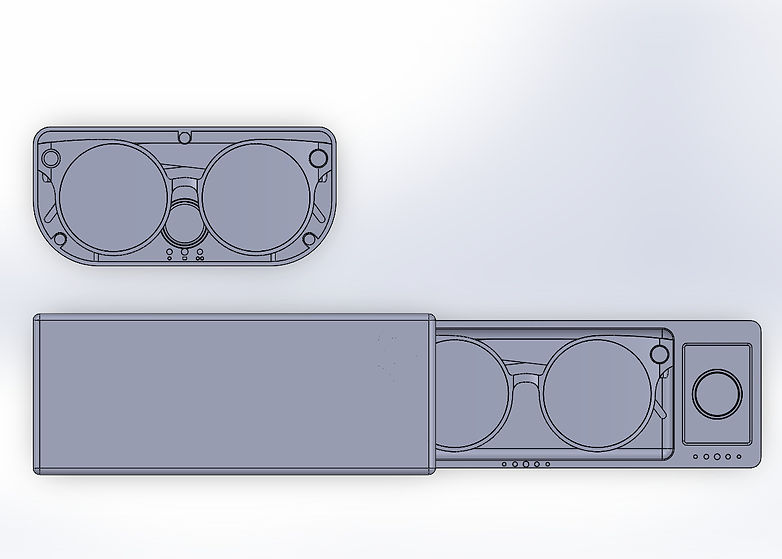
Opened Case
Combining the section in which the glasses and ring are stored significantly reduced the size in which the case sits closed, and changing the way the case opens reduced the size by more than half.